

Often Wrong, Never in Doubt
What Maslow, Myers-Briggs, a card game, and a Porsche taught me about confident ignorance.

Last week at Lake Anna, my son Lucas and I were playing cards when I said — with complete confidence — “Did you know that seven shuffles is all you need? After that the deck can’t get any more random.”
He paused. “I don’t think that’s right, Dad.”
I pushed back. He pushed back harder. He then pulled out Claude Opus to dig into the actual research.
He was right. I was wrong.
The seven-shuffle rule is real but oversimplified. The deck approaches true randomness asymptotically — each additional shuffle adds less and less, but the difference between shuffle seven and shuffle eight is not zero. It approaches negligible. The clean, confident version I’d been citing for years was pop trivia stripped of nuance. I had never actually checked it.
I’m a dad. Dads are supposed to know things. And I was so sure I did.
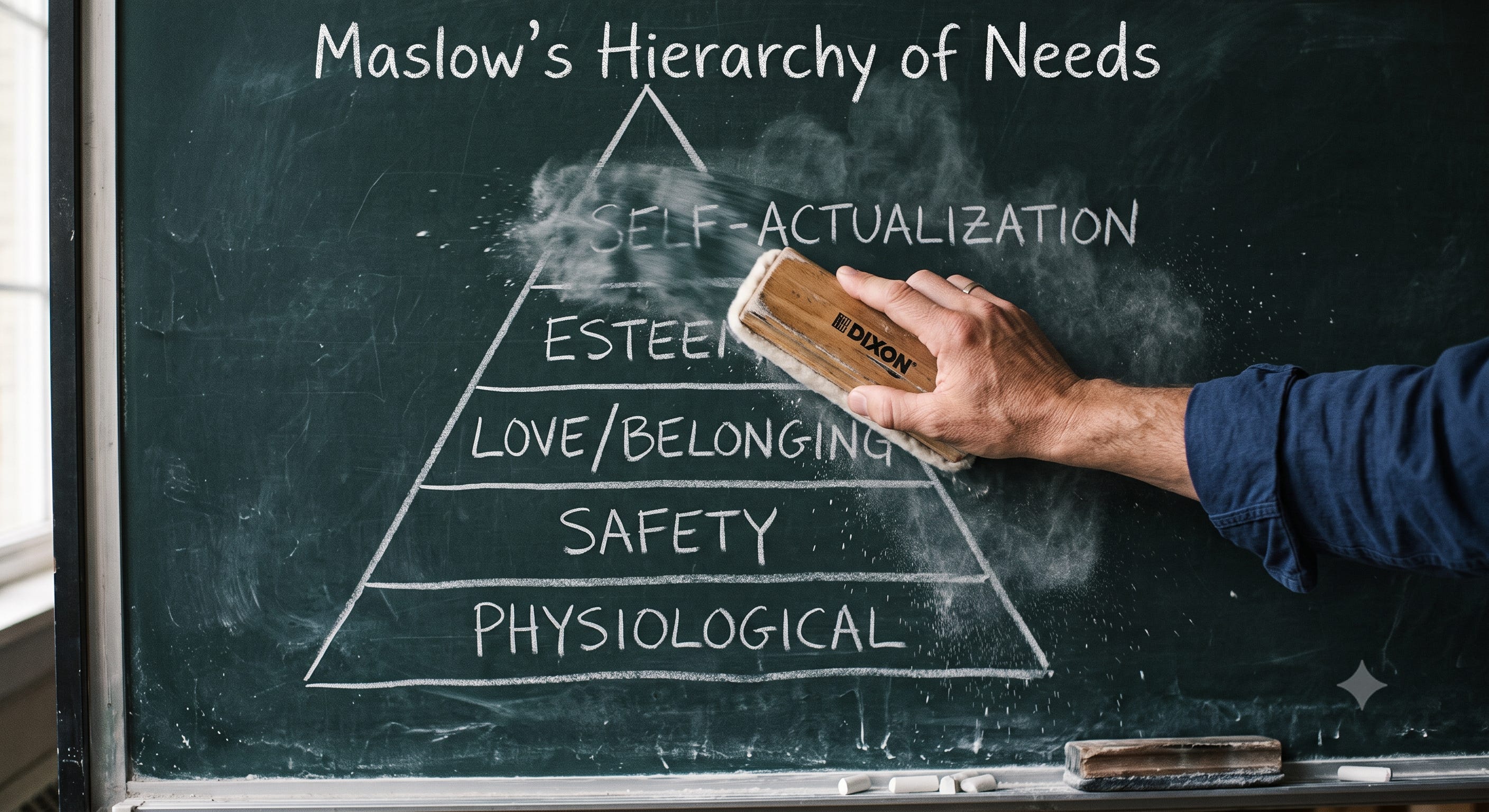
But here’s what that moment cracked open for me: I’m not one bit different from the person in the meeting who pulls out Maslow’s hierarchy of needs like it’s settled science — confident, slightly authoritative — as if the triangle on a PowerPoint slide ends the conversation.
It doesn’t. And I think it’s worth saying why.
There’s a phrase that’s been floating around long enough to belong to everyone and no one: “Often wrong, never in doubt.”
It was supposedly the unofficial motto of editorial writers for decades. Atul Gawande used a version of it about surgeons — “sometimes wrong, never in doubt” — meant as a reproof but, he noted, also their greatest strength. Confidence in the face of uncertainty gets things done. But it also gets things wrong, loudly and repeatedly, in ways that other people then cite for fifty years.
That’s the real story of Maslow’s pyramid. And Myers-Briggs. And my seven shuffles.
Maslow’s Hierarchy: The List Is Real. The Pyramid Is Fiction.
The largest empirical test of Maslow’s theory used Gallup World Poll data from 123 countries and roughly 60,000 people. The verdict: the needs Maslow named — basic, safety, social, respect, mastery, autonomy — are real and cross-culturally robust predictors of wellbeing. The taxonomy holds up reasonably well.
But the hierarchy? The actual thesis of the model? Empirically dead.
Fulfillment of one need was not found to be dependent on fulfillment of another. A person can pursue and benefit from self-actualization without having met their need to belong. The struggling artist creating transcendent work from poverty and isolation isn’t an anomaly — according to 60,000 data points, she’s completely normal.
And here’s the detail I enjoy most: Maslow never drew the pyramid. The iconic triangle was a later management textbook invention that detached from the source and then got cited as the source for fifty years. The most famous image in pop psychology was made up by someone else entirely.
The needs are real. The architecture is fiction. Modern motivation science has largely moved to Self-Determination Theory — developed by Deci and Ryan — which is empirically rigorous and actually predicts things.
Myers-Briggs: The Test That Can’t Remember You.
Nearly 75% of people who retake the Myers-Briggs within five weeks receive a different personality type. That’s not a minor measurement issue — it’s a fundamental reliability failure. A personality test that gives you a different answer about yourself in five weeks isn’t measuring who you are. It’s measuring your mood that Tuesday morning.
If you want a personality framework built on actual science, the Big Five — openness, conscientiousness, extraversion, agreeableness, neuroticism — is what research psychologists use. It’s been validated across cultures, predicts real outcomes like job performance and relationship satisfaction, and holds up when you retake it. Less catchy than a four-letter type. Considerably more true.
The Porsche Problem.
A friend once told me with complete confidence that a Porsche 911 is more reliable than a Toyota Camry. It sounded completely absurd. Of course the Toyota is more reliable — everyone knows that.
But when I actually looked into it, things got murkier, not clearer. It turns out the automotive world is fighting a civil war over what “reliability” even means. Consult J.D. Power and my friend looks spot on — the Porsche 911 consistently ranks among the most dependable vehicles on the market, with almost no manufacturing defects right off the line.
Then, check RepairPal and my common sense is vindicated — Toyota ranks near the top of the industry while Porsche sits dead last out of 32 brands, largely because its repair costs are punishing. Whether the 911 beats the Camry depends entirely on whether you’re measuring the perfection of the factory or the survival of your bank account.
My friend was certain. I was certain of the exact opposite. Neither of us had the full picture. We were both doing the thing.
Why This Keeps Happening.
There’s a well-documented phenomenon called the Illusory Truth Effect: repeated exposure to a claim makes it feel more true, regardless of its accuracy. Maslow’s pyramid has been on PowerPoint slides for sixty years. Of course it feels true. It’s been repeated into credibility. Myers-Briggs has been administered to millions of people in corporate settings for decades. The confidence of the institution substitutes for the evidence behind the tool.
And here’s the social layer that makes it worse: the more confidently someone states something, the less we demand evidence.
Confidence substitutes for citation. That’s not stupidity — it’s a deeply wired social shortcut. We evolved to trust decisive people in ambiguous situations. In a world of pop psychology and trivia, it’s exactly the wrong instinct.
I’m not exempt. I cited the seven-shuffle rule for years. I was certain about the Camry. And I’m the dad who was supposed to know.
This isn’t about other people being credulous. It’s about a universal human tendency to let familiarity and confidence do the work that evidence is supposed to do.
The solution isn’t to become paralyzed by uncertainty or to demand citations in every conversation. It’s something smaller: hold your confident claims a little more lightly. (That’s what I’m trying really hard to do now.)
Be curious when someone pushes back instead of defensive. And extend the same grace to others — because the person citing Maslow in a meeting isn’t uniquely credulous. They’re just human, doing the same thing you did the last time you were certain about something you hadn’t actually checked.
I learned that from a card game at a lake house. My son, and Claude, were right. I was wrong. And I’m a better thinker for it.
Your Move.
Pick one thing you cite with confidence — a psychological fact, a statistic, a piece of received wisdom you’ve been carrying for years — and actually look it up this week.
Dig in. Not to prove yourself wrong. Just to find out whether what you know is what’s true.
The gap between those two things is more interesting than most people expect.
— Curt
Great article! Thought-provoking and right on time for me. Many thanks.